
Dumpster Rental in Pierce County, WA
Lime green roll-off containers dispatched from our Canyon Road yard to job sites across the south Sound — the Port, the Puyallup valley, the 512 corridor, and out to the west side. Demolition, roofing tear-off, concrete and flatwork, tenant improvement, land clearing. If your crew is producing construction debris in Pierce County, we have a box sized for it.
Pick a size, pick a delivery date, and we handle the haul.
Container sizes for Pierce County job sites
Five sizes cover the work down here. Picking between them is mostly a weight question rather than a volume one — a quarter-full box of broken slab outweighs a packed box of framing offcuts, and the scale is what settles the bill. The complete container size guide puts the dimensions and typical scopes side by side if you are deciding between two.
- 10 Yard Rock Box20 × 8 × 2 ft
- The only container rated for weight. Specifically designed for concrete hauling — built heavy, and sized so you fill the box before you hit the weight limit. Concrete, dirt, rock, brick, asphalt.
- 15 Yard Roll-Off12 × 8 × 5 ft
- Built for tear-off and tight lots. A composition roof strip or a bathroom gut fits without paying for space you will not use, and it sets where a longer box cannot swing clear.
- 20 Yard Roll-Off14 × 8 × 5.5 ft
- The one most crews end up on. Mixed C&D from a kitchen or whole-floor remodel, flooring, roofing on a larger structure. Enough capacity that you are not calling for a swap mid-week.
- 30 Yard Roll-Off20 × 8 × 6 ft
- For work that produces debris every day. Framing, interior demo on a commercial scope, new build. Bulky material goes in fast, so this is a volume decision rather than a weight one.
- 40 Yard Roll-Off20 × 8 × 8 ft
- The biggest box we run, for the biggest jobs. Full structure demolition, large construction scopes, commercial teardown — work that fills a 30 before the week is out.
One hard rule: heavy material goes in the rock box and nowhere else. Concrete, dirt, rock, brick, and asphalt are dense enough that a larger box cannot be legally hauled once it is loaded.
Why Rainier
You talk to the people who run the trucks
Small office, dedicated team. Whoever takes your call knows your job, your site, and what went out last week. No call center, no ticket number, no explaining the same access problem twice.
Same-day and next-day scheduling
Orders placed early in the day usually go out the same day, and next day otherwise. Follow-through is the part that matters — you find out when the box is coming, and it comes.
Dump and returns, load and gos
Not every job needs a swap-out. If the box just needs emptying and bringing straight back, we do that. If your crew is loading direct and the truck waits, we do that too. Ask for what the job actually needs rather than working around what is on a menu.
Trucks that fit where the big ones don't
Our 15 and 20-yard containers go places a full-size roll-off truck cannot — off a north end alley, behind the building, down a driveway that dead-ends. Small nimble trucks built for tight access. If another company looked at your site and passed, tell us what the approach looks like and we will say straight whether we can make it work.
LEED documentation on certified projects
Loads route to a materials recovery facility that issues a diversion report off the load — tonnage in, tonnage recovered, the percentage that stayed out of the landfill. That is the paperwork a GC submits toward MR credits. Most haulers cannot tell you where your debris ended up. Tell us the project is chasing certification when you book and we route accordingly.
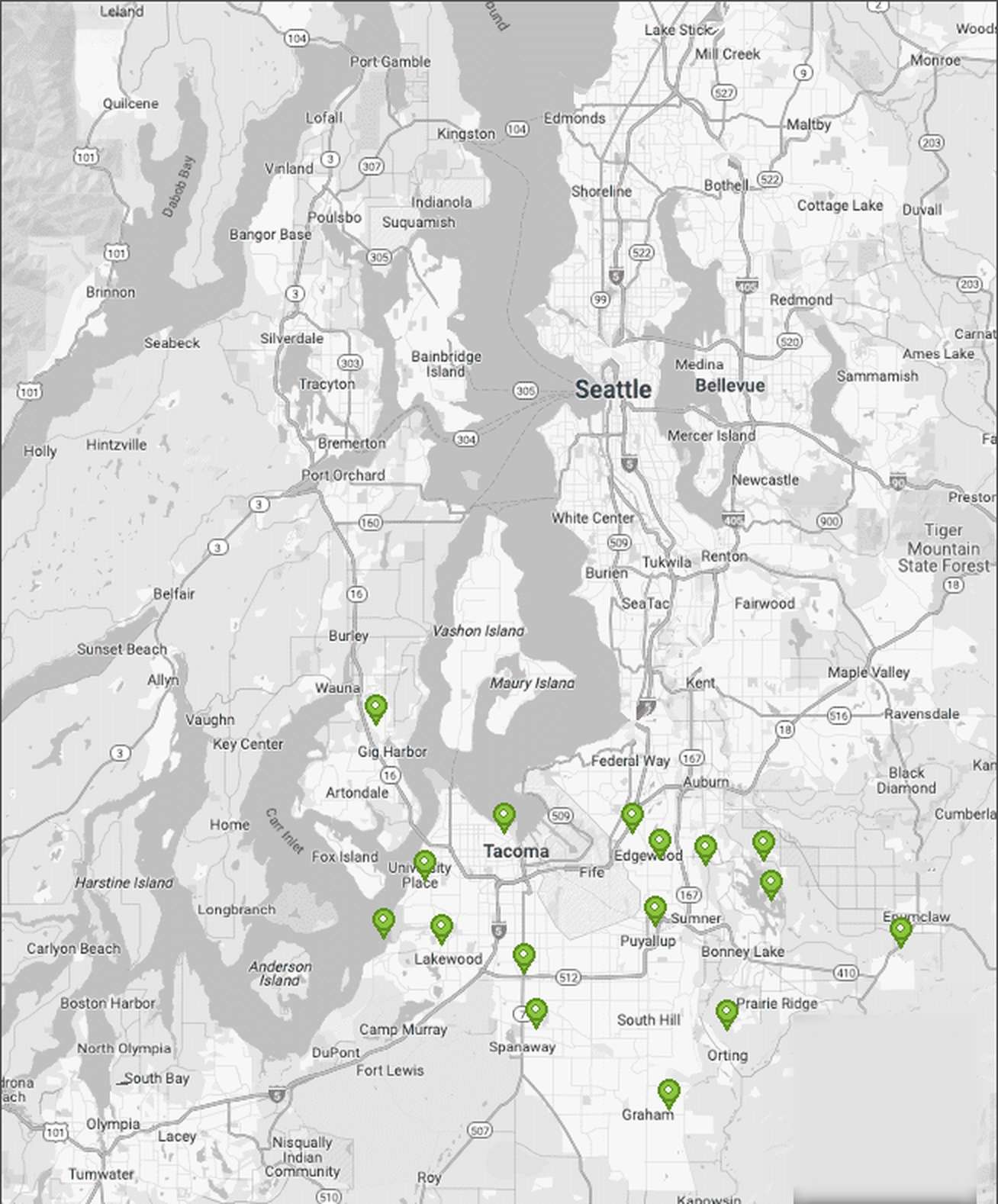
Pierce County Cities We Deliver To
Coverage reaches from the Port and downtown south to the county line, east up the river valley, up over the plateau, and west across the lakes to the water. We run outside Pierce and King regularly — if your job is further out, ask.
Our trucks run routes rather than working outward from one point, and the office builds each day against the schedule. The truck coming to your site is usually already out, so a city's position on the map is not what determines whether we can get to it. The area notes below say what each part of the county produces and where the access problems are, so you know before delivery day whether your site needs a heads-up.
- Bonney Lake construction debris
- Buckley container hauling
- Edgewood job site roll-offs
- Gig Harbor renovation containers
- Graham land clearing debris
- Lake Tapps waterfront remodels
- Lakewood dumpster rentals
- Milton tear-off containers
- Orting valley deliveries
- Parkland demolition roll-offs
- Puyallup container delivery
- Spanaway site debris hauling
- Steilacoom project delivery
- Sumner roll-off service
- Tacoma roll-off rental
- University Place remodel debris
Tacoma and the Port
Tacoma is the busiest service on this side of the operation. The work splits three ways: industrial and warehouse turnover around the Port and the tideflats, tenant improvement downtown and along the Hilltop corridor, and residential remodel and teardown work in the older north and east end neighborhoods. Those older streets are narrow, frequently on a grade, and often have overhead lines to clear — tell dispatch what the approach looks like and the right truck shows up the first time.
South of the city the same route carries Parkland, Spanaway, and University Place. Parkland and Spanaway run to commercial and multifamily volume along the Pacific Avenue corridor, with steady demolition and site work as older parcels turn over. University Place is quieter and mostly renovation — kitchens, additions, and re-roofs on established lots. All three sit close enough to the city that they share a truck with Tacoma most days.
Across the Narrows, Gig Harbor is mostly waterfront renovation and addition work, frequently on steep driveways and narrow shoreline lanes where the set spot is worth working out before the truck is on its way. The shoreline access is the thing to flag when you book, not the crossing. Book ahead where the job allows and same-day still happens when the schedule has room.
Puyallup and the valley
Puyallup is where our Pierce County operation is based. The valley floor carries a steady mix of new residential construction, ag outbuilding demolition, and commercial work along the Meridian and 512 corridors. Valley ground is soft through the wet months and fill soils here run heavy, which matters twice: once for the truck, and once at the scale.
Just upriver, Sumner covers the warehouse and distribution belt along the river along with the residential work spreading east toward the foothills. Sumner and Puyallup usually sit on the same route, so a crew with jobs in both is dealing with one schedule rather than two.
North of Puyallup, Edgewood and Milton sit right on the King County line and work as a single area with Auburn and Federal Way on the other side of it. Crews out there are often running jobs on both sides of the boundary in the same week, and our routing follows the work rather than the line — a crew with jobs in Milton and Auburn is on one schedule with us, not two.
Upriver at the far end, Orting covers the top of the valley: new residential construction, ag outbuilding demolition, and land clearing as larger parcels get divided up. Book ahead where the job allows and the dispatcher will fit it into the day's routing.
The plateau
Up the hill east of the valley, Bonney Lake, Lake Tapps, and Buckley cover the eastern edge of our Pierce County coverage. Bonney Lake is the busiest of the three — sustained new construction and build-out along the plateau, with the finish-stage debris that comes with it. Lake Tapps is waterfront remodel and teardown work, and access is the thing to flag there: long private drives, shared lake lanes, and set spots with very little room to turn a truck around.
Buckley runs to rural work — outbuildings, barns, land clearing, and the occasional whole-structure demolition. Book ahead where you can, and tell us what the approach looks like when the access road in is narrow or unimproved. That is the constraint on the plateau, not the map.
Lakewood and the west side
Lakewood reaches the western edge of the county, including the base-adjacent commercial and multifamily work that drives a lot of the volume there. We are credentialed for base access as well, so a job on Joint Base Lewis-McChord itself is a container we can actually get through the gate rather than a dead end. Book ahead where the schedule allows and same-day is regularly workable when the day has room in it.
Steilacoom sits just past it on the water, and it is small, historic, and tight. Narrow streets, mature trees over the roadway, and short set windows on the older blocks. It is all workable, but it is the kind of site where the approach wants describing at booking rather than sorting out on delivery day.
South of both, Graham is rural and spread out — land clearing, outbuilding demolition, site work on acreage, and new construction on large lots. Addresses are not always obvious from the road out there, so a gate code and a landmark save the driver a lap.
What actually drives the cost of a container
We do not publish figures, because a number with no job attached is not useful to anyone — the booking tool prices your real scope in about a minute. What moves the total is worth understanding before you order:
- Size. Cubic yards of capacity. Ordering one size up almost always beats paying for a second haul on a box you overfilled.
- Material weight. Disposal is billed by tonnage. This is the largest variable in Pierce County, and it is why dense material is restricted to the rock box.
- Duration. Standard rental periods cover most jobs. Arrange an extension before pull day rather than after — it is simpler and it keeps the box on site.
- Permits. Right-of-way placement means a permit from whichever jurisdiction owns the street, and they do not all work alike.
- Access. Soft ground, gated sites, tight alleys, and overhead lines all affect how long a set takes and sometimes what truck it needs.
Those five are worth more than a figure would be, and we go through each of them in detail on the Tacoma cost page — including which ones you can actually change once the job is booked. If you would rather haul it yourself, the Tacoma transfer station takes self-haul loads.
Rather talk it through? Call the Pierce County office and you will get someone who knows the routes.
(253) 753-8183Permits, placement, and access in Pierce County
A container on private property — a driveway, a lot, a fenced job site — needs no permit and is the straightforward case. The moment the box lands on a public street, a planting strip, or a sidewalk, the jurisdiction that owns that right-of-way gets involved, and Pierce County is not uniform here. Tacoma runs its own right-of-way process. Unincorporated Pierce County runs another. Puyallup, Sumner, and Lakewood each handle it locally. None of it is difficult, but it is worth a phone call before delivery day rather than a conversation with a code officer after.
For placement, plan on about 30 feet of straight approach and 10 feet of overhead for a 15 or a 20 on our smaller trucks, and about 60 feet and 15 feet for the rock box, the 30 or the 40 on our full-size CDL trucks. Plywood under the rails protects finished concrete and we bring it when you flag the surface in advance. Through the wet season, say something if the drop spot is on unimproved valley ground — a truck buried to the axles on a soft lot costs a day that nobody budgeted.
Scheduling and dispatch
Dispatch runs Mon–Fri 7:00 AM – 6:00 PM. Orders placed early in the day can usually be set the same day, and next day otherwise — what decides it is how committed the day already is, not which part of the county you are in. On an active demolition site, call the number in the header and the dispatcher will work a swap-out into the routing rather than leaving a crew standing around a full box.
Working in King County? Jobs north of the county line run out of our other yard, on a different number with a different crew. The King County service area page has the coverage, the contacts, and the cities we reach up there.
Common questions from Pierce County contractors
Which container can I load concrete or dirt into?
Only the 10-yard rock box. It is the single container in the Pierce County fleet built to carry dense material, and the 15 and 20 cannot take it. Valley soils run wet and heavy, so a box of what looks like ordinary fill weighs more than crews expect.
Do we need a right-of-way permit, and who issues it?
If the box sits in the public right-of-way, yes, and Tacoma administers that separately from unincorporated Pierce County and from the smaller valley cities. On a private driveway or a fenced site you generally do not. Call the Canyon Road office before delivery and we will tell you what your jurisdiction expects.
How much clearance does the truck need?
It depends on the size. The 15 and 20 ride our smaller trucks: roughly 30 feet of straight approach and about 10 feet of overhead. The 10-yard rock box, the 30 and the 40 ride our full-size CDL trucks: roughly 60 feet and about 15 feet. Older Tacoma neighborhoods with narrow streets and overhead lines are workable, but flag the constraint when you book so dispatch sends the right truck.
Can you swap a full container the same day?
On active demolition sites, usually yes, if the call comes in early. Swap-outs are routine work and our trucks are already out running the day, so an exchange is a scheduling question rather than a trip we start from scratch. Give us as much notice as the job allows and the dispatcher will work it into the routing.