
Dumpster Rental in King County, WA
Lime green roll-off containers delivered to job sites from Woodinville to North Bend, dispatched out of our Renton yard on Renton-Maple Valley Road. Demolition, roofing tear-off, concrete, tenant improvement, land clearing — if your crew is generating construction debris in King County, we have a box for it and a truck that knows the route.
Pick a size, pick a delivery date, and we handle the haul.
Container sizes for King County job sites
Five sizes cover the work we see across the county. The right one is a question of what the debris weighs, not just how much of it there is — a half-full box of broken slab is a heavier load than a full box of framing offcuts. If you are weighing two options, the full container size comparison lays out the dimensions and typical scopes side by side.
- 10 Yard Rock Box20 × 8 × 2 ft
- The only container rated for weight. Specifically designed for concrete hauling — built heavy, and sized so you fill the box before you hit the weight limit. Concrete, dirt, rock, brick, asphalt.
- 15 Yard Roll-Off12 × 8 × 5 ft
- Built for tear-off and tight lots. A composition roof strip or a bathroom gut fits without paying for space you will not use, and it sets where a longer box cannot swing clear.
- 20 Yard Roll-Off14 × 8 × 5.5 ft
- The one most crews end up on. Mixed C&D from a kitchen or whole-floor remodel, flooring, roofing on a larger structure. Enough capacity that you are not calling for a swap mid-week.
- 30 Yard Roll-Off20 × 8 × 6 ft
- For work that produces debris every day. Framing, interior demo on a commercial scope, new build. Bulky material goes in fast, so this is a volume decision rather than a weight one.
- 40 Yard Roll-Off20 × 8 × 8 ft
- The biggest box we run, for the biggest jobs. Full structure demolition, large construction scopes, commercial teardown — work that fills a 30 before the week is out.
One hard rule: heavy material goes in the rock box and nowhere else. Concrete, dirt, rock, brick, and asphalt are dense enough that a larger box cannot be legally hauled once it is loaded.
Why Rainier
You talk to the people who run the trucks
Small office, dedicated team. Whoever takes your call knows your job, your site, and what went out last week. No call center, no ticket number, no explaining the same access problem twice.
Same-day and next-day scheduling
Orders placed early in the day usually go out the same day, and next day otherwise. Follow-through is the part that matters — you find out when the box is coming, and it comes.
Dump and returns, load and gos
Not every job needs a swap-out. If the box just needs emptying and bringing straight back, we do that. If your crew is loading direct and the truck waits, we do that too. Ask for what the job actually needs rather than working around what is on a menu.
Trucks that fit where the big ones don't
Our 15 and 20-yard containers go places a full-size roll-off truck cannot — off a Seattle alley, behind the building, down a driveway that dead-ends. Small nimble trucks built for tight access. If another company looked at your site and passed, tell us what the approach looks like and we will say straight whether we can make it work.
LEED documentation on certified projects
Loads route to a materials recovery facility that issues a diversion report off the load — tonnage in, tonnage recovered, the percentage that stayed out of the landfill. That is the paperwork a GC submits toward MR credits. Most haulers cannot tell you where your debris ended up. Tell us the project is chasing certification when you book and we route accordingly.
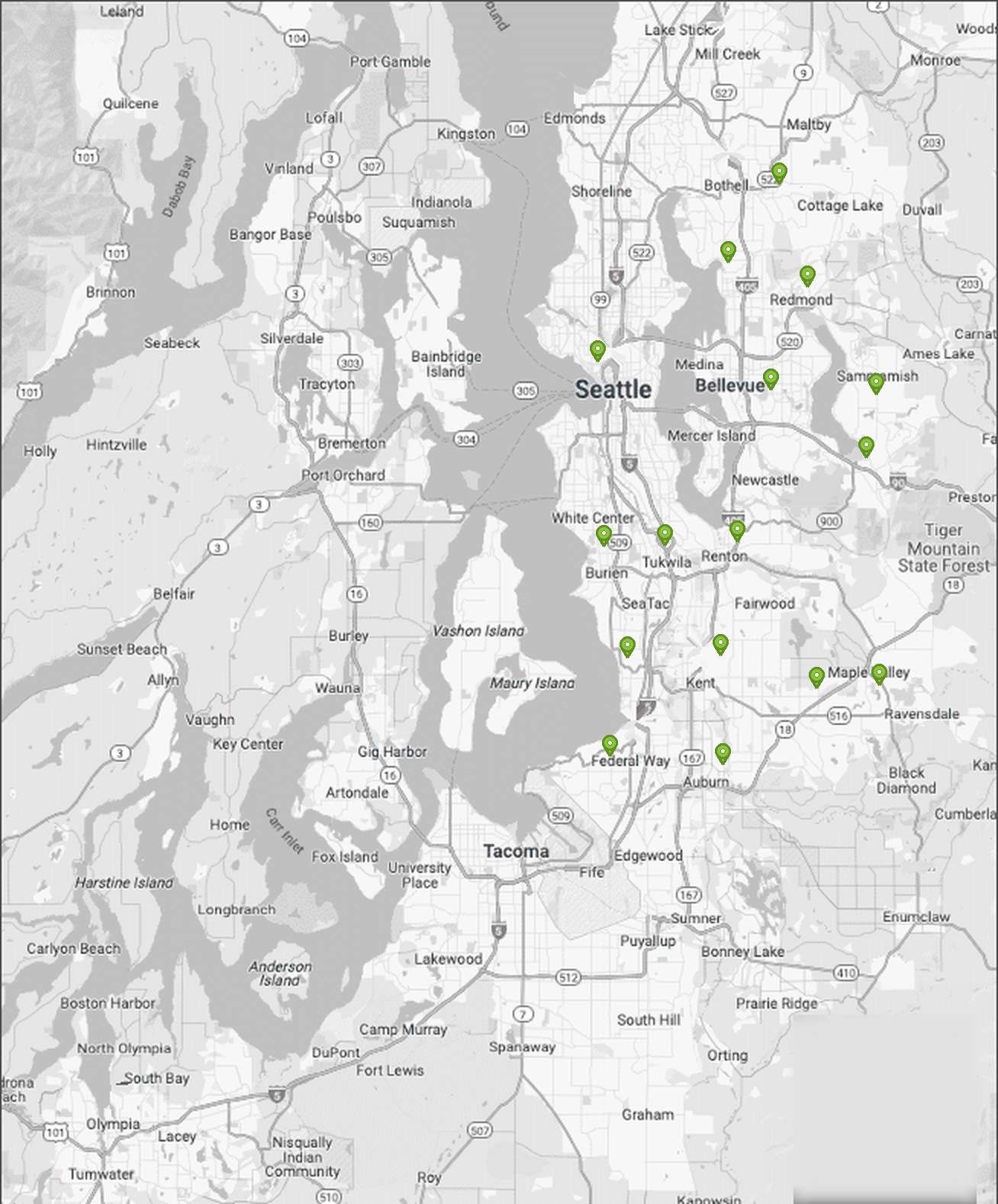
King County Cities We Deliver To
Coverage runs north to the county line, east up the I-90 corridor, and south through the Green River valley to the Pierce County line, taking in the valley floor, the Cedar River corridor, and the Eastside. We run outside King and Pierce regularly — if your job is further out, ask.
Our trucks run routes rather than radiating out from one point, and the office builds the day against the schedule. A truck heading to your site is usually already out working, so where a city sits on the map is not what decides whether we can serve it. The area notes below cover what each part of the county actually produces and where access gets complicated, so you can flag the approach when you book rather than on delivery day.
- Auburn dumpster rentals
- Bellevue construction sites
- Burien roll-off delivery
- Covington container rental
- Des Moines
- Federal Way roll-off delivery
- Issaquah
- Kent job site delivery
- Kirkland remodel containers
- Maple Valley project roll-offs
- North Bend roll-off rental
- Redmond project containers
- Renton roll-off service
- Sammamish
- Seattle container rental
- Tukwila container delivery
- Woodinville job site containers
Renton, the valley, and the south county
The busiest part of our King County work. Renton is where our containers and trucks are based, and the valley work runs through Tukwila, Kent, and the Highway 18 side of the county into Covington and Maple Valley. Auburn sits at the hinge of the service area — that crew works north into Kent and south past the county line on the same day.
Seattle and the west side
City work has its own constraints: narrower streets, alley placements, and permits that actually get checked. Seattle is our most requested urban service, and the crews running it are used to steep driveways and short set windows. South and west of the city we cover Burien and Federal Way, which shares a working area with the south Sound.
The Eastside
Tenant improvement and commercial remodel volume is heaviest here, along with the residential teardown-and-rebuild work moving through the older neighborhoods. We deliver to Bellevue, Kirkland, Redmond, and Woodinville.
The upper I-90 corridor
East, past the plateau, North Bend handles the upper valley — land clearing, cabin remodels, and outbuilding demolition, often on acreage where the access road matters more than anything else. Book ahead where the job allows and flag the approach; same-day goes out when the schedule has room for it.
What actually drives the cost of a container
We do not publish figures, because a number without the job attached is useless — the booking tool prices your actual scope in about a minute. What moves the total is worth knowing before you book:
- Size. Cubic yards of capacity. Ordering one size up is almost always cheaper than a second haul on a box you overfilled.
- Material weight. Disposal is billed by tonnage at the scale. Dense debris is the single largest variable, which is why heavy material is restricted to the rock box.
- Duration. Standard rental periods cover most jobs. Long-running projects can extend, and it is cheaper to arrange that in advance than to discover it on pull day.
- Permits. Right-of-way placement means a city permit, and King County jurisdictions do not handle this uniformly.
- Access. If the truck cannot reach the drop spot, the crew works around it. Overhead lines, soft ground, and gated sites all affect how long a delivery takes.
Rather talk it through? Call the King County office and you will get someone who knows the routes.
(425) 522-3717Permits, placement, and access in King County
Placement on private property — a driveway, a lot, a fenced site — is the simple case and needs no permit. The moment a container sits on a public street, a planting strip, or a sidewalk, the local jurisdiction is involved, and requirements are not consistent across the county. Seattle handles right-of-way occupancy differently than Bellevue, which handles it differently than the smaller valley cities. Unincorporated King County has its own process again.
Plan for about 30 feet of straight approach and 10 feet of overhead for a 15 or a 20 on our smaller trucks, and about 60 feet of approach and 15 feet of overhead for the rock box, the 30 or the 40 on our full-size CDL trucks. Plywood under the rails protects a finished driveway, and we bring it when you flag the surface in advance. On soft ground in the shoulder seasons, tell us before delivery: a truck sunk to the axles on a wet lot costs everyone a day.
Scheduling and dispatch
Dispatch runs Mon–Fri 7:00 AM – 6:00 PM. Orders placed early in the day can usually be set the same day, and next day otherwise — it depends on what the day is already committed to rather than on where the job is. Swap-outs on an active demolition site are routine: call the number in the header and the dispatcher will work the exchange into the routing rather than making your crew stand down waiting on an empty box.
Working in Pierce County? Jobs south of the county line run out of our second yard on a different number and a different crew. See the Pierce County service area for coverage, contacts, and the cities we reach down there.
Common questions from King County contractors
Which container takes concrete, dirt, or asphalt?
The 10-yard rock box, and only the 10-yard rock box. It's built for it — thicker wall gauge, and short enough to load over the rail. The 15 and 20 are lighter-gauge boxes that will take damage under that kind of weight, and even if they didn't, a full one puts the truck over legal axle weight. Load concrete into a 15 or 20 and the driver won't take it. The box sits on your site until your crew empties it by hand.
Do I need a permit to put a container on the street?
If the box sits on a public right-of-way, the city issues the permit and requirements vary across King County. On private driveways and job sites you generally do not need one. Call the Renton office before delivery day and we will tell you what your jurisdiction expects.
How much room does the truck need for delivery?
It depends on the size. The 15 and 20 ride our smaller trucks and need roughly 30 feet of straight clearance to set a box and about 10 feet of overhead. The 10-yard rock box, the 30 and the 40 ride our full-size CDL trucks and need roughly 60 feet and about 15 feet. Tight Seattle alleys and steep driveways are workable, but tell us in advance so we send the right truck and pick a realistic drop spot.
Can I keep the container past the original haul date?
Yes. Extensions are routine on King County jobs when weather or inspections slip the schedule. Let us know before the scheduled pull so we can keep the box on site and re-slot the haul.