
Roll-Off Dumpster Rentals in Seattle, WA
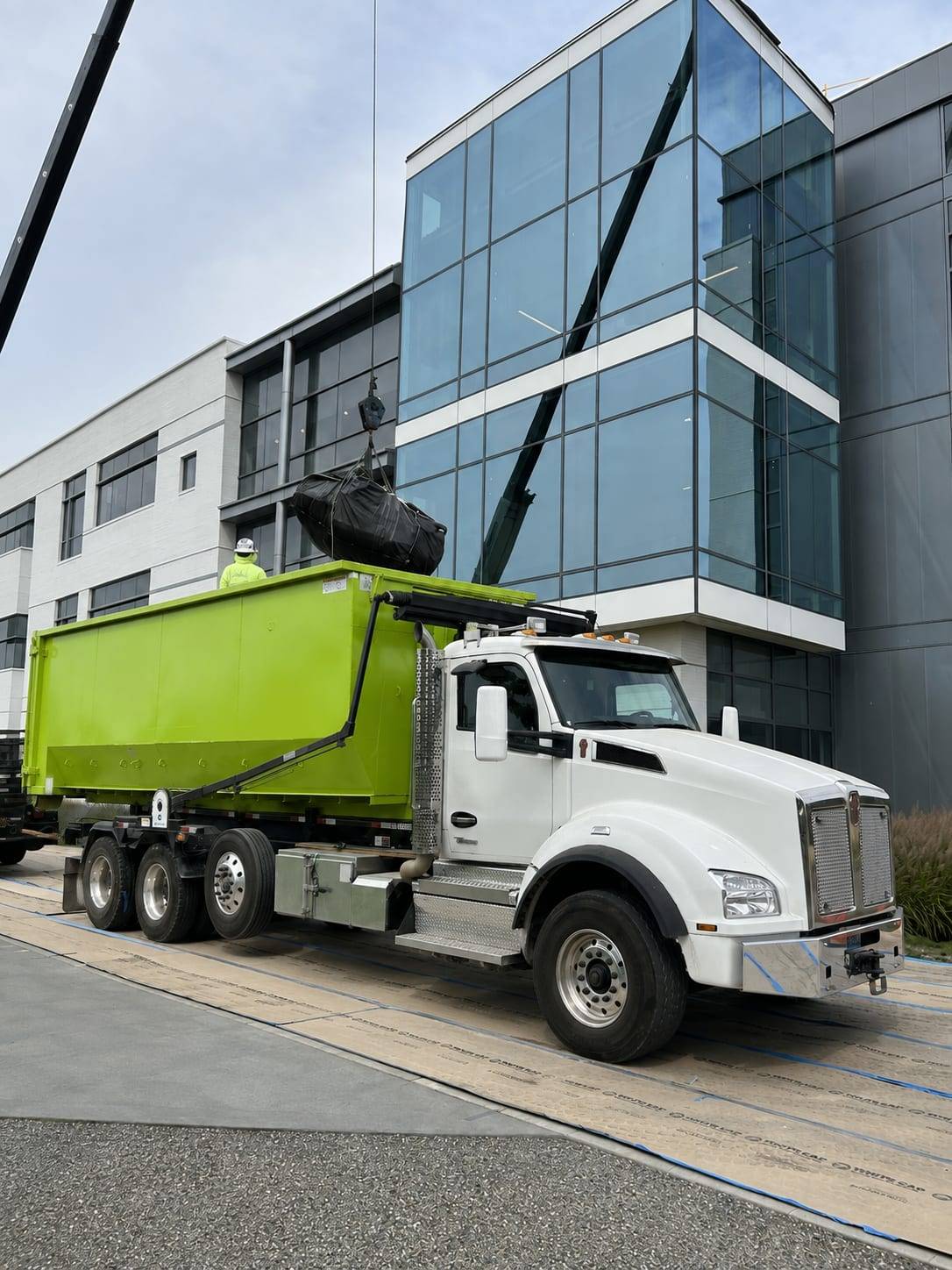
Seattle is the densest city we serve, and here the hard part is never the debris — it is finding somewhere legal and workable to put the box. Narrow platted streets, alleys behind everything, lots with no off-street space, real grade, and a city that actually enforces its right-of-way rules. We run smaller trucks for exactly this, and we know what SDOT will and will not sign off on.
Pick a size and a delivery date. Describe the street and we will tell you what will work.
What we bring to Seattle
Two things, and the first one is the reason most Seattle contractors call us.
We reach sites a full-size truck cannot. The 15 and 20-yard containers go out on a smaller truck than the 30 and the 40. That is an operational fact rather than a sales line, and Seattle is where it earns the most. The older plats were laid out long before anyone was reversing a roll-off truck down them: streets are narrow before cars park on both sides, lots are deep and thin, alleys run behind whole blocks, and an enormous number of properties have no off-street space at all. A smaller truck gets into an alley, a shared drive, a service side, or a dead-end lane where a full-size one has nowhere to go. How we handle tight access generally covers what actually stops a delivery and what to tell us at booking.
If another company has looked at your site and said no, this is the call worth making. Tell us the width at the pinch point, what is overhead, and where a truck would have to turn, and you will get a straight answer. Sometimes it is still no — but you get that answer before you have built a crew day and a permit application around a delivery that was never going to happen.
Documented diversion for projects that need it. Seattle applies construction and demolition diversion requirements that most of the suburbs around it do not, and on a permitted project the paperwork is part of the job. We route loads to a materials recovery facility that issues a diversion report off the load — tonnage in, tonnage recovered. To be exact, because it matters: the facility certifies the diversion, not us. What we control is where the load goes. Tell us at booking that the project has diversion obligations and we route accordingly.
Neither of those makes Seattle a specialist job. All five sizes run here and every ordinary scope is routine for us in the city — these are just the two worth raising before you book.
What Seattle actually builds
Four kinds of work, and which one you are doing decides almost everything about the delivery.
The dense older residential ring
Ballard, Fremont, Wallingford, the north end and the Central District carry most of the residential work, and the stock is old enough to generate a constant stream of it: re-roofs, kitchen and bath remodels, plaster and lath out, knob-and-tube rewires, basement and foundation work, additions, and teardown-and-rebuild on lots worth more than the structures on them. Chimney and masonry removal comes up far more here than in newer cities, because far more of these properties still have one.
What defines the work operationally is that almost none of these sites has anywhere obvious to put a container. The alley behind the block is usually the answer, and where there is no alley the answer is a permitted spot in the parking lane.
The industrial south end
SODO, Georgetown and South Park are the one part of Seattle where a delivery looks like the valley: flat ground, wide streets built for truck traffic, private yards and gates, and room to set a container without touching the right-of-way. The work is warehouse and light industrial turnover — interiors reconfigured for a new tenant, racking out, office fit-out inside a shell — plus the outdoor cycle of dock and apron repair, yard slab replacement, and paving. Volumes are larger and the boxes are bigger.
Downtown, South Lake Union, and the urban villages
Commercial and tenant improvement work, in the core and in the dense mixed-use pockets spread through the city. A lease ends, a floor is stripped to the shell, the next tenant fits out: ceiling grid, partitions, casework, flooring, shopfittings, and a great deal of packaging once the fit-out starts.
The constraint downtown is that there is frequently no private ground at all. Placement is a loading bay, a permitted lane, or a service alley, and every one of those has a time window attached to it. This is the part of the city where the permit and the delivery have to be planned together.
The hills and West Seattle
Grade deserves its own mention because it changes what is possible. Much of the city sits on real slope — Queen Anne, Magnolia, Capitol Hill, and West Seattle in particular — and a container has to be set level and stay put once it is loaded. A steeply pitched driveway or a cross-sloped parking strip can rule out the convenient spot entirely, and some of these areas carry additional restrictions on slope and drainage that affect what a site can do. The practical answer is usually the flat spot rather than the near spot, and it is worth identifying before delivery day.
Which containers Seattle jobs book
All five run here, and the split follows the four markets above:
- Alleys, tight lots, and permitted street placement. Our compact 15-yard handles a single-room gut or one of the smallest roofs where the street is the problem, and our compact 20-yard reaches the same places with the capacity a full remodel or a house re-roof actually needs. Both go out on the smaller trucks.
- Concrete, chimneys, and foundations. Masonry teardowns, basement digs, flatwork and spoils go in a rock box for concrete and spoils. It is the only container rated to carry that weight.
- Tenant improvement and warehouse strip-out. Our 30-yard for commercial work is the workhorse in the south end and on larger TI scopes — bulky debris, hand-loaded, arriving all day.
- Full demolition and machine-fed work. A 40-yard for full demolition moves the same material in fewer hauls, on sites with room to take it.
If you are weighing two of them, see every size we run, compared with dimensions and typical scopes side by side.
Rather talk it through? Call the King County office and you will get someone who knows the routes.
(425) 522-3717Access and placement around Seattle
Seattle asks more of a delivery than any other city we serve. The constraints are not exotic individually — it is that they stack, and a site usually has three of them at once.
Alleys. Frequently the right answer, because the alley is where the space is when the street has none, and they suit the smaller trucks. Width is the deciding factor and it varies a great deal across the older plats, so measure at the tightest point rather than estimating. We also need to know whether it runs through or dead-ends, what is overhead, and what tends to be parked in it — an alley that is clear on a Tuesday morning is not necessarily clear on a Friday afternoon.
No staging space. On a lot with no driveway and no off-street parking, there is nowhere to stage material and nowhere to put the box except the alley or the street. That has a scheduling consequence most people miss: the container's arrival and departure both have to be planned rather than assumed, because there is no in-between spot to move it to.
Overhead lines. Setting a container means lifting it clear and lowering it, then lifting it again on the way out, so a service line over the drop spot is a hard constraint even where the ground is wide open. The older neighborhoods carry a lot of overhead service and it hangs lower than it looks from a car.
Grade. A box has to sit level and stay level once loaded. On the hills that regularly rules out the obvious spot, and the answer becomes the flat stretch further along rather than the one outside the house.
Enforcement. This is the difference between Seattle and almost everywhere else on our list. An unpermitted container in the right-of-way is not a technicality here — it gets noticed, and it becomes your problem rather than the driver's. Plan the permit as part of the job rather than as an afterthought.
Permits and right-of-way in Seattle
Placement on private property — a driveway, a lot, a fenced job site — needs no permit. In the south end that covers most of the work. In the residential ring it frequently covers none of it.
Where a container has to sit on a public street, a planting strip, or a sidewalk, the City of Seattle administers that right-of-way and you need its permission before delivery day. In Seattle that permission is a street use permit from SDOT, applied for through the Seattle Services Portal, and it covers the alley as well as the street. In paid parking zones you will also need "No Parking" signage posted ahead of the delivery so the space is actually free when the truck arrives, and that posting has its own lead time.
Say plainly what the suburbs let you get away with and Seattle does not: this process is genuinely stricter and it is genuinely enforced. Most cities on our list will never look at a box sitting in a parking strip for a weekend. Seattle will. Build the permit lead time into the schedule from the start, because discovering it late is the single most common way a Seattle job slips.
Certain areas carry additional review on top of the street use question — steep slope and drainage-sensitive areas in particular. If your site is on significant grade, check what applies before you plan the placement. And if you are not sure which permit path your site needs, call us: we deliver into these neighborhoods constantly and can usually tell you what has worked at an address like yours.
Roofing tear-off in Seattle
Roofing is the single most requested scope in this city — enough that it has a page of its own, and one that draws more search traffic than this page does. A composition strip on older Seattle stock brings its own version of every constraint above: the container has to be close enough to the roof to load, small enough for the street, and gone the day the crew finishes. Roofing tear-off in Seattle covers the sizing, the timing and the placement directly.
Neighboring cities we cover
Our routing follows the work rather than the city limit, so containers on two of these sites are one schedule with us:
- Tukwila roll-offs — south, retail and warehouse turnover on the valley corridor.
- containers in Burien — southwest, remodels and re-roofs.
- Bellevue deliveries — east across the lake, tenant improvement and teardown-and-rebuild.
Seattle is one stop on our King County job sites, which lists every city we reach north of the county line.
Common questions from Seattle contractors
Can you get a container into a Seattle alley?
Often, and it is one of the most common things we are asked here. The 15 and 20-yard containers go out on a smaller truck than the 30 and 40, which is what lets them work an alley, a shared drive, or a lot with no off-street space. What we need from you is the width at the tightest point, whether the alley runs through or dead-ends, what is overhead, and what is likely to be parked in it. Alley widths vary a lot across the older plats, so measure rather than estimate if it is close.
Do I need a permit to put a container on the street in Seattle?
Yes, and Seattle is stricter about it than the suburbs around it. Occupying the right-of-way — a travel lane, a parking lane, a planting strip, a sidewalk — needs a street use permit from SDOT, applied for through the Seattle Services Portal. In paid parking zones you also need "No Parking" signage posted in advance of the delivery. Build the permit lead time into the schedule rather than the other way round; Seattle does check, and an unpermitted box in the right-of-way is your problem, not the driver's.
What if the site has no driveway and no off-street parking?
Extremely common in the older neighborhoods, and usually workable. The options are the alley behind the property, a permitted spot in the parking lane out front, or a neighbouring lot if someone will agree to it. Which one is realistic depends on the street, so describe the frontage and the alley when you book and we will tell you which to pursue before you spend a week on a permit for the wrong one.
Which container takes concrete from a foundation or a chimney?
The 10-yard rock box, and only that one. Concrete, dirt, rock, brick, and asphalt are dense enough that any larger container would exceed what a truck can legally haul once loaded. Put heavy material in a 20 and the driver refuses the pickup on haul day — the box stays loaded on your site until the crew offloads it. Basement digs and chimney removals in the older stock are the usual version of this in Seattle.